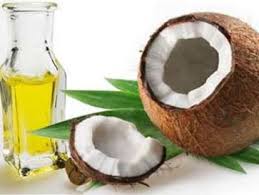
Photo courtesy of Phu Thinh Co. CC BY-SA 2.0
The Hype:
Coconut oil is seems to be having it’s heyday right now. Good for your body, good for your skin, good for your hair. Their are also many health claims associated with coconut oil. It has reached super-food status. So, how does it really break down?
The Science:
Coconut oil is a medium-chain saturated fatty acid, a rather unique fatty acid. Most saturated fats come from an animal source and are of the short-chain variety. Most vegetable oils are unsaturated fats. But there is this third category of a select few medium-chain saturated fats from plants. Palm oil and cocoa fat also fit into this third category.
These medium-chain saturated fatty acids (MCSFAs) are unique in how they are absorbed into the body. While most fats require the assistance of bile salts to get absorbed through the intestinal walls, MCSFAs are somehow water soluble and immediately pass right through the intestinal wall and head right to the liver. This special feature of MCSFAs has made them very useful in treating patients with nutrient absorption issues in the medical arena. Once in the body, MCSFAs are converted into acetic acid, which is an important component in the synthesis of ATP (otherwise known as ‘energy’)(1). The limited scientific research available shows that coconut oil may actually increase HDL (good cholesterol), while not affecting total cholesterol or LDL (bad cholesterol) significantly (2).
My Two Cents:
What’s not to like —
It is tasty.
It is a fat that is actually used for energy in the body.
It has been shown to be good for the heart.
It is from a natural source.
That is a pretty nice nutrition profile in my book. So, what is the best way to use coconut oil?
Oils have something called the smoke point. This is literally the temperature at which the oil smokes when heated. All fats have a different smoke point. When cooking, ideally we do not want to reach a fat’s smoke point, because at this point the oil’s chemistry may change and become unstable, creating free radicals. Free radicals cause damage to cells within the body; this is not a desirable food characteristic. In general, oils with the highest smoke point are best suited for high temperature cooking, those with a medium smoke point are best suited for sautéing and baking, and those with a low smoke point are best used fresh without heat (3).
Coconut oil is semi-liquid at room temperature, and becomes a solid with lower temperatures (like in the fridge). According to this chart from the Cleveland Clinic (3),
http://health.clevelandclinic.org/2014/10/heart-healthy-cooking-oils-101/, coconut oil has a medium smoke point, making it a good choice for cooking when sautéing and baking.
When buying coconut oil, choose virgin coconut oil, which indicates that it is the least refined, purest oil available. All in all, it is a great choice for low to moderate heat cooking and baking. It is a popular ingredient in body cleansers and moisturizers. It is also used in a process called ‘oil pulling’ which I will examine in a blog soon. I’ve used it in both sugar scrubs for the skin and in baking. I use it to bake a delicious granola. I’d be interested to learn more ways people are using it in their diet, so please leave a comment if you enjoy using coconut oil.
References
Mahan L.K., Escott-Stump S. Krause’s Food, Nutrition, and Diet Therapy, 10th ed. 2000 W. B. Sounders Company.
Babu AS, Veluswamy SK, Arena R, Guazzi M, Lavie CJ. Virgin coconut oil and its potential cardioprotective effects. Postgrad Med. 2014 Nov; 126(7):76-83. http://www.ncbi.nlm.nih.gov/pubmed/25387216#
Cleveland Clinic. Heart-Healthy Cooking: Oils 101 http://health.clevelandclinic.org/2014/10/heart-healthy-cooking-oils-101/


